


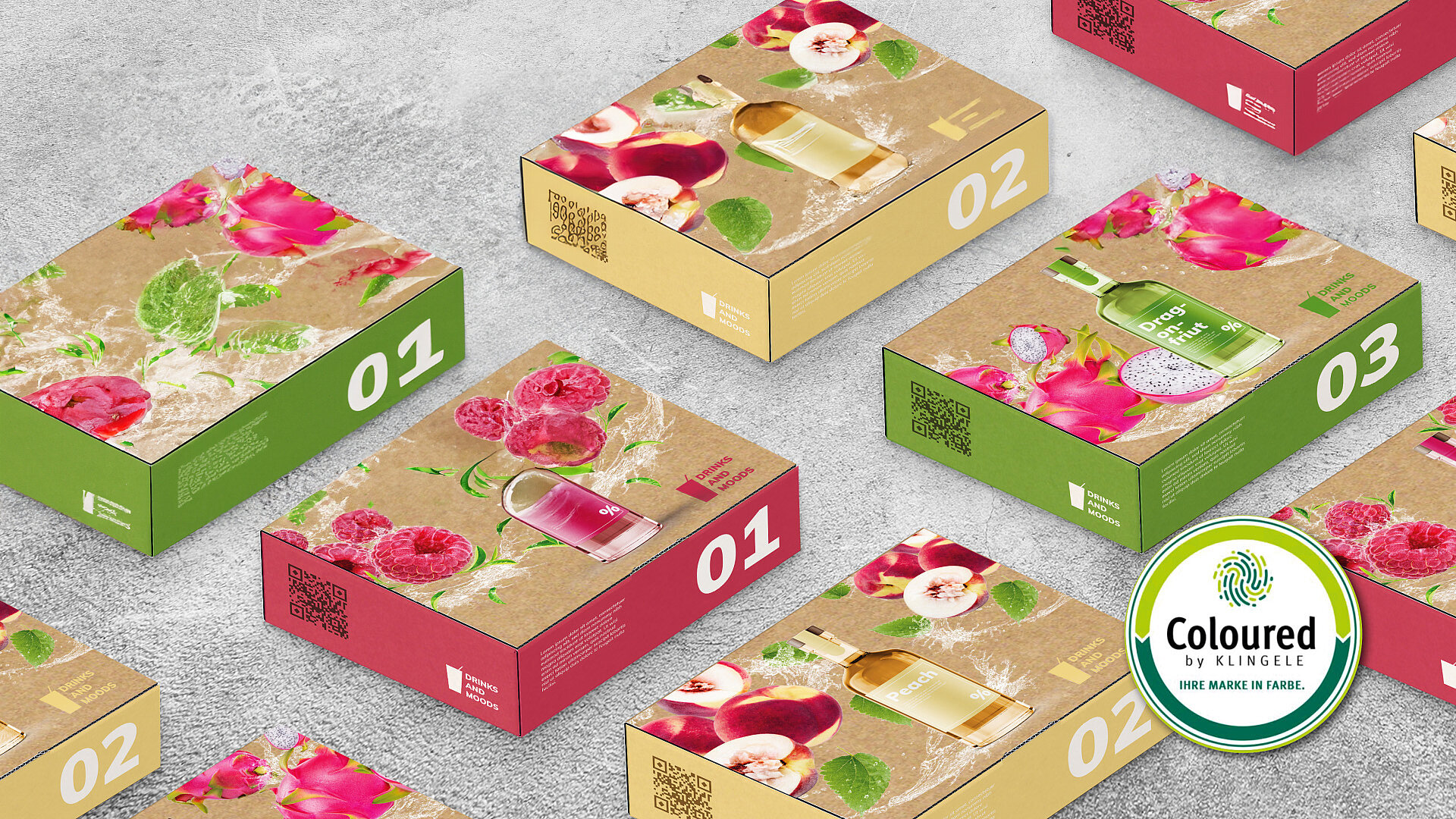


Klingele design guidelines for recycling
Clear guidelines for packaging that can be optimised for the waste paper cycle
Designed for the cycle from the outset - our corrugated and solid board packaging follows clear design principles for good waste paper recycling. Our aim is to combine packaging functionality, brand and legal security with a strong focus on recyclability. The actual recyclability always depends on the local collection and recycling systems and the specific material composition of your packaging.

Four building blocks for cycle-orientated packaging
Our design guidelines help you to develop packaging that conserves resources and functions reliably in the processes - from construction to recycling.
Material design
Balanced use of materials for utilisation, product protection and paper recycling
1. Prioritise monomaterial, additional components made of foreign materials such as plastic must be easily separable.
- Use of corrugated cardboard/paper as the main material throughout.
- Avoid permanent material composites that are difficult to separate in waste paper sorting.
- Functional layers (e.g. barriers) only where they are technically necessary - and should, if possible, be easily separable and account for less than 5% of the total packaging weight.
Your benefit
Less material mix, clearer cycle: Simplified materials support categorisation and recycling in the waste paper stream.
2. Material & barrier management
- Use coatings selectively and sparingly.
- Preferably use systems that are compatible with recycling (e.g. certain dispersion barriers, depending on the project).
- Avoid composite laminates, especially if they make fiber recovery from waste paper significantly more difficult.
- The coatings should not contain any hazardous substances as defined by the PPWR.
Your benefit
They provide the necessary product protection and at the same time reduce the risk of packaging being rejected from paper recycling due to critical composites.
3. Printing, varnish & adhesives
- Use of water-based, low-migration printing and coating systems - especially for packaging used in the food industry.
- Flexographic printing inks formulated without mineral oil should be preferred.
- Only print on inner surfaces where it is really necessary.
- Use easily removable, preferably paper-based labels.
- No dark colouring due to carbon black-based pigments, which pose a recycling problem.
Your benefit
More careful handling of fibers and auxiliary materials supports high-quality recycling and facilitates evaluation in the context of recycling tests and ratings.
Constructive design
Function, handling and recycling in harmony
1. Packaging construction & design optimisation
- The packaging should be designed in such a way that the empty packaging can be erected and laid flat as easily as possible and without any additional aids.
- Clear opening aids that maintain stackability as far as possible even after opening.
- The construction and design should be based on the GS1 "Shelf Ready Packaging" Guidelines.
- Reduction of grammage and flute thickness (if technically possible).
Your benefit
Sturdy, logistics-friendly packaging with corrugated and solid board that is optimally* prepared for the waste paper cycle.
2. Labelling & documentation
- Clear disposal pictograms and material codes on the packaging,
- Brief and comprehensible instructions for correct separation (e.g. removal of inlays, bags or closures, if necessary),
- Supplementary information in the technical data sheet or specifications,
Your benefit
They support retailers and end consumers with correct disposal and create transparency - a plus point for brand confidence and practical recyclability*.
3. Compliance, verification & legal certainty
- The manufacturer must provide a food safety declaration for food contact materials and articles.
- If required, the producer provides technical documentation (drawings, product specifications and other evidence) so that the customer or producer (as defined by the PPWR) can prove conformity.
- Orientation towards industry-relevant initiatives and regulations (e.g. FEFCO recommendations).
Your benefit
You gain legal and technical certainty and can demonstrate to customers, retailers and stakeholders how your packaging has been developed with recyclability* in mind.
* Information on the recyclability of corrugated cardboard and corrugated cardboard packaging
Information on recyclability relates to the design and material selection of the packaging. Actual recycling depends on correct disposal and local collection, sorting and recycling systems.
In addition to the most important raw material, paper, starch is also used to bond the individual layers of paper in the production of our corrugated cardboard and corrugated cardboard packaging. If the corrugated cardboard is printed and sealed during further processing, printing inks and glue are also used. Some of the starch can be reused in the subsequent recycling process for the production of waste paper-based papers. On the other hand, glue and printing ink, as well as any non-paper components such as plastics or mineral components that may be introduced via the waste paper, cannot be recycled. These are sorted out by the paper mills and, where possible, sent for thermal utilisation. The corrugated cardboard or corrugated cardboard packaging we produce is considered recyclable in accordance with PTS method RH 021-97 and can therefore be classified accordingly in accordance with the German Packaging Act on the basis of its main component, paper.
From the concept to the right packaging solution
Using our design guidelines as a basis, we work with you to develop project-specific packaging solutions that take functional, legal and utilisation requirements into account. Just ask us.